
A Rust crate for collecting Channel State Information (CSI) on ESP32 series devices using
the no-std embedded framework.


Want CSI without writing code?
esp-csi-cli-rsis a CLI wrapper with pre-built binaries that exposes everything this crate does — flash it and talk to the board over serial.
esp_csi_rs builds on top of Espressif's Rust esp-hal and esp-radio crates' low-level abstractions to enable easy CSI collection on embedded ESP devices. The crate supports various modes and network configurations and integrates with the esp-wifi and embassy async ecosystems.
- Device Support: supports all ESP devices supported by the
esp-haland have WiFi or ESP-NOW radio support. - Host Support: Where supported,
esp-csi-rsleverages theUSB-JTAG-SERIALperipheral to allow higher baud rates compared to traditional UART. - Multi Output Support: postcard/COBS frames, plain text, a compact array format, the ESP32-CSI-Tool CSV layout, or
defmt. - Traffic Generation: supports the generation of different types of traffic and control of traffic rate.
- Network Architechtures: supports the creation of several network architechtures & topologies introducing flexibility for different network setups.
- Multi Mode Support: supports multiple modes operational modes, including ESP-NOW, Wi-Fi, and raw 802.11 emitter packets.
- 802.11bf Ready: is ready for 802.11bf support. 802.11bf devices would integrate as an additional node mode.
- 802.11bf Collection Model: adopts the 802.11bf CSI collection and measurement terminology.
A CSI sensing network deployment is a set of nodes sharing a channel in which traffic (or soundings) excite the channel and at least one node reports a measurement of it. Measurments are taken in sessions and each node in a collection network has a role during that session.
The measurement node in a collection network can report the CSI locally to the collecting node itself (ex. for extra processing) or deliver it using a transport to a host. Measurements are also captured in measurement sessions. During a session CSI is captured/measured under a certain set of configuration parameters until the session concludes.
The sensing architechture is split in two tiers:
- The Host Tier (Controller): This is the external orchestrator that could be the ESP application, a PC, a Python script, a server, or a host application (like esp-csi-cli-rs over a serial/UART link or network). It sends measurement configurations and collects or analyzes the resulting data. It oversees the experiment or sensing deployment.
- The Embedded Tier (The Node): This is the physical ESP32 device running the firmware. It exists on the channel to actually participate in Wi-Fi sensing by either transmitting sensing PPDUs, measuring incoming frames (calculating CSI), or both. A node is never the system-level controller because the node is the entity being orchestrated.
Each node is described by four independent attributes, compatible with IEEE 802.11bf's terms wherever the standard has one:
- Mode: defines how does it reach the channel.
- Session Role: defines who is the initiator of a measurement session. A node can be an initiator or a responder.
- Sensing Role: defines who does what in a sensig session. A node can be a transmitter or a reciever.
- Reporting Policy: defines how the collected measurements are reported.
esp-csi-rs defines the following contsrutors for the different modes:
| Constructor | Mode | Session role | Sensing role | Reporting Policy |
|---|---|---|---|---|
CsiNode::sniffer |
Wi-Fi sniffer | none | receiver | report, threshold-based or decimate |
CsiNode::station |
Wi-Fi station | initiator or none | transmitter-receiver or receiver | any |
CsiNode::access_point |
Wi-Fi access point | initiator | receiver | any |
CsiNode::emitter |
Raw 802.11 frames | none | transmitter | none |
CsiNode::esp_now |
ESP-NOW | initiator or responder | transmitter-receiver | any |
CsiNode::esp_now_simplex_source |
ESP-NOW simplex | initiator | transmitter | none |
CsiNode::esp_now_simplex_peer |
ESP-NOW simplex | responder | receiver | report |
Below are some of the different network shapes that could be deployed.
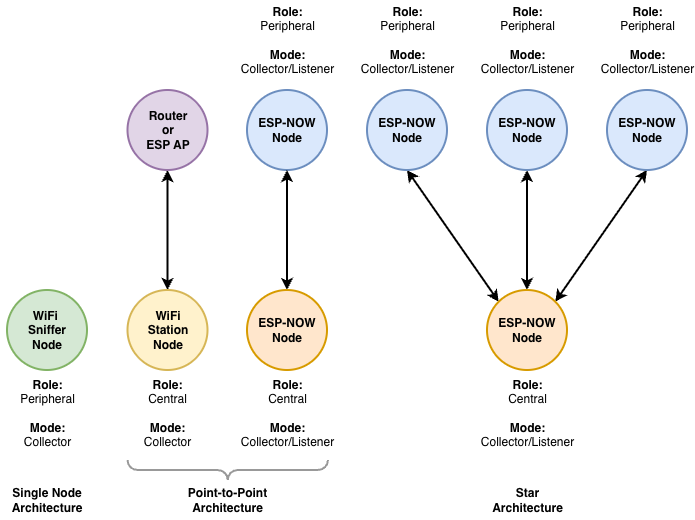
docs/network-model.md is the normative description, including how the
model maps onto IEEE 802.11bf.
The architrecture of the system is split into two types of hardware:
- The collection hardware which is typically the ESP device.
- The processing hardware which can be the ESP itself or a host computer.
The processing hardware typically decodes the reported measurements, processes them and stores or analyzes them.
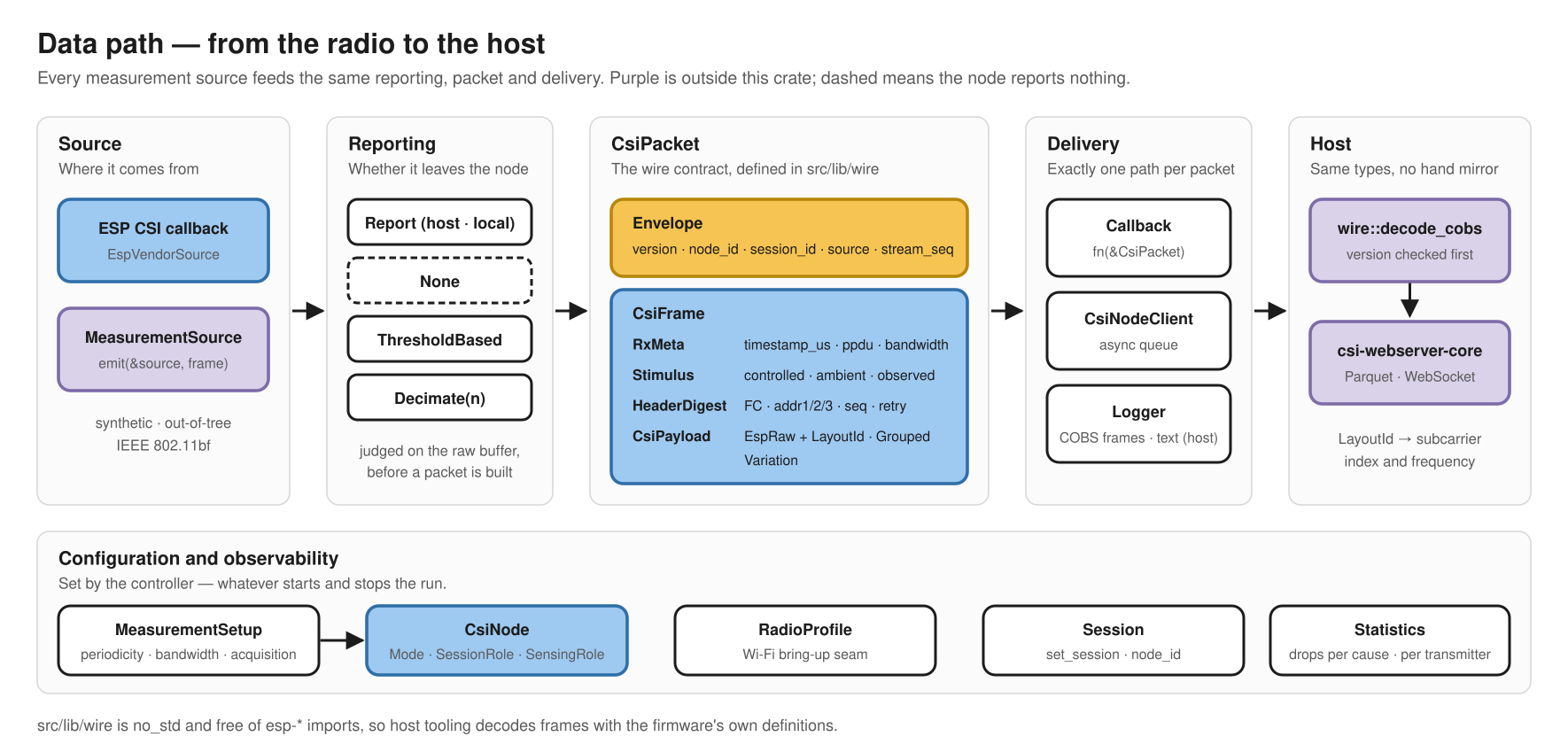
On the collection hardware the architechure is split into a controller and a data path. The controller lives in the ESP application and defines the measurement setup and parameters. The data path is mostly defined in esp-csi-rs and can live completely on the ESP device or split between the ESP and a host.
The data path is split into two parts.
- The Capture Path: This is the callback inside the WiFi task that copies over the recieved CSI data, determines where it will be reported, and places it in a record.
- The Delivery Path: This is the path that defines how the CSI records will be delivered.
The figure below visualizes the flow.
Some of the crate abstractions are defined in the table below:
| Abstraction | Role |
|---|---|
Mode, CsiNode |
How the node reaches the channel; one constructor per mode |
SessionRole, SensingRole |
The node's IEEE 802.11bf roles, read back from the mode |
Reporting, ReportTo |
Whether, and how often, measurements leave the node, and where to |
CsiPacket → Envelope |
Format version, node id, session id, source kind, per-run frame counter |
CsiPacket → CsiFrame |
Normalised RxMeta, the Stimulus that excited the channel, an optional HeaderDigest, and a CsiPayload (EspRaw tagged with its LayoutId, Grouped, Variation) |
wire |
The frame format itself: no_std, radio-neutral and free of esp-* imports, so hosts decode with the same types |
MeasurementSource, emit |
Feed frames from any source through the same policy, statistics and delivery |
MeasurementSetup |
The node's measurement setup: periodicity, bandwidth, acquisition |
wire::MeasurementSetup |
The serialized IEEE 802.11bf-style setup a controller sends (periodicity, bandwidth, responders), mapped onto the mode |
RadioProfile |
Seam for custom Wi-Fi bring-up |
get_drop_breakdown, snapshot_tx_stats |
Drops per cause and per-transmitter counters (statistics feature) |
Make sure to add esp-csi-rs to the list of dependencies in Cargo.toml:
[dependencies]
esp-csi-rs = { version = "0.13", features = ["esp32c3", "println"] }In this configuration we simply pass the WiFi controller hardware instance and measurement setup to create a sniffer that sniffs packets on channel 7 using the measurement defualts.
In the example, controller is the WifiController from esp_radio::wifi::WifiController::new. NodeHardware is an abstraction that claims its interfaces and handles.
use esp_csi_rs::{CsiConfig, CsiNode, MeasurementSetup, NodeHardware, WifiSnifferConfig};

// Device HAL and Controller instantiation

let mut node = CsiNode::sniffer(
    WifiSnifferConfig::default().with_channel(7),
    MeasurementSetup::new().acquisition(CsiConfig::default()),
    NodeHardware::new(controller),
);
node.run().await;In this configuration we pass the WiFi controller hardware instance and measurement setup to create an emitter that emits packets on channel 7 using the measurement defaults.
And an emitter for it to measure:
use esp_csi_rs::{CsiNode, EmitterConfig, EmitterPhy};

// Device HAL and Controller instantiation

let emitter = EmitterConfig::new(7, EmitterPhy::Ht20)
    .with_period(embassy_time::Duration::from_millis(20));
let mut node = CsiNode::emitter(emitter, NodeHardware::new(controller));For more examples Refer to the examples directory. Heres a table for the different examples that exist:
| Example | What it does |
|---|---|
sniffer |
Locks a channel and measures every frame overheard |
emitter |
Unassociated sounding at HT20, HT40 or HE20; pair with sniffer |
station |
Associates to an ESP softAP or a commercial router |
access_point |
Self-contained softAP with DHCP; associated stations generate the uplink |
esp_now |
The symmetric connectionless pair |
esp_now_simplex |
The asymmetric pair — the highest CSI rate of any pairing |
csi_callback |
Inline callback vs. queued delivery |
runtime_config |
Reconfiguring one node between runs |
synthetic_source |
A non-radio MeasurementSource feeding 802.11bf-shaped reports through emit (synthetic feature) |
To build an example run the following:
cargo esp32c3 --example sniffer          # println
cargo esp32c3-defmt --example sniffer    # defmt
Replace esp32c3 with esp32, esp32c5, esp32c6 or esp32s3. Measurement harnesses are in
experiments/.
| Document | What is in it |
|---|---|
docs/network-model.md |
The node model and its relation to IEEE 802.11bf |
docs/bandwidth.md |
HT20, HT40 and HE20, and filtering legacy/ACK CSI |
docs/emitter-support.md |
Which transport each chip's emitter uses |
docs/defmt.md |
Logging backends and using defmt |
wire on docs.rs |
The frame format, subcarrier layouts and measurement setup |
| docs.rs | Full API documentation |
Copyright 2026 The csi-rs Team. Licensed under either of
- the Apache License, Version 2.0 (
LICENSE), or - the MIT license (
LICENSE-MIT),
at your option.